
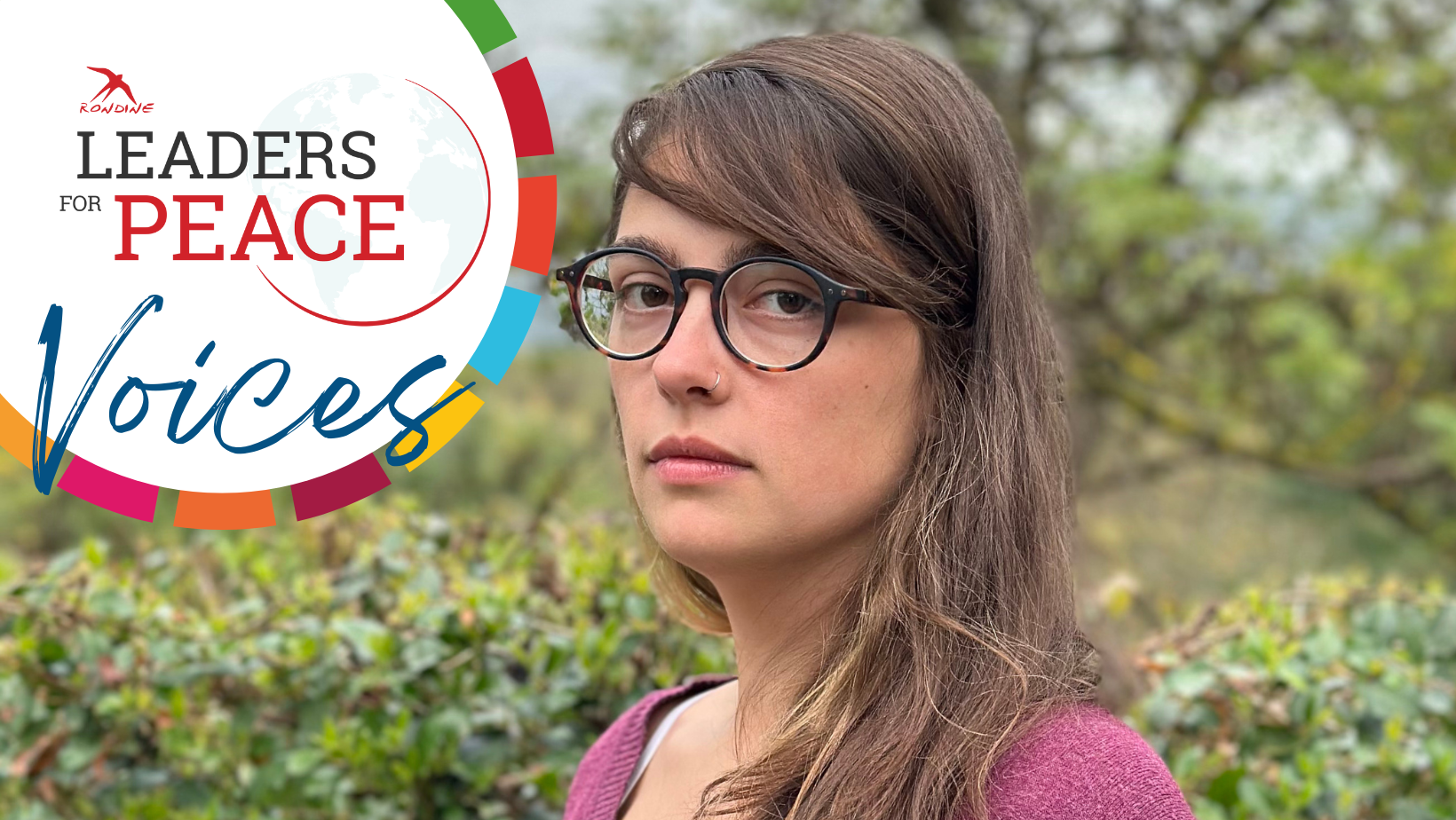
With the article of Teodora Markovic, we publish the eighth contribution to the Leaders for Peace Voices series, which brings together the testimonies of young international leaders trained by Rondine.
On the occasion of the International Day for the Elimination of Violence against Women and Girls (November 25th), Teodora shares an authentic and powerful reflection on digital violence against women and girls, urging us to recognize how violence has transformed and permeated the online spaces we inhabit every day.
Through her journey as a Rondine fellow and as part of a community committed to peace, Teodora takes us on a path of awareness — inviting us to look beyond the screen, challenge indifference, and transform responsibility into daily action for dignity, safety, and peace.
Digital violence against girls and women is the theme of this year’s global campaign, 16 Days of Activism against Gender-Based Violence, which begun on the International Day for the Elimination of Violence against Women and Girls (November 25th), and lasted until December 10th – International Human Rights Day.
It is mid-December now, and the sixteen days are over. The orange banners are coming down, or perhaps they were never really up, existing only as pixels on a screen we scroll past in the dark. The hashtags stop trending. It is mid-December now, the light is low, and we are left with the subject at hand: the digital violence against women. The United Nations asked us to look at this, really look at it, for two weeks. The theme was UNiTE to End Digital Violence – a directive that feels less like a slogan and more like a plea to notice the water in which we are all currently drowning. It is a simple enough phrase, but it covers a difficult new reality.
We have always told ourselves stories about where violence lives. We imagined it in the street, in the unlit alley, behind the locked door of a domestic argument. It was physical, it had a location. But the landscape has shifted, and the geography of danger is no longer physical: it is everywhere. It is in the pocket of your (yes, your!) coat, it is on the nightstand. It is glowing in the palm of your (!) hand. The violence has moved into the code, into the blue light of the interface, and in this new arrangement, there is no such thing as walking away. The mistake we made was thinking the internet was not the real world. We told ourselves that words on a screen were just ghost stories, that they couldn’t hurt you. This was never true, but now it is dangerously false. The violence has followed us online, and it has become more efficient. More than ever, peace looks like an abstract. But peace is not merely the absence of conflict; it is the presence of safety, justice, and the freedom to speak without fear. At Rondine Cittadella della Pace, where young people from conflict zones around the world gather to transform enemies into friends, we understand that there can be no true peace without the security of women. With over 60% of the current students at Rondine being women, the urgency of this issue is not theoretical but rather personal. From the Balkans to the Caucasus, from the Middle East to Africa and South America, we carry the stories of our sisters, mothers, and friends. We united to ensure that during these sixteen days, our small but precious community would not stay silent. Our response was a series of activities designed to educate, disrupt, and unite – events organized by women, but for everyone.
It is time to discard the idea that the internet is a separate place, because it is the place. And as long as it remains a jurisdiction without law, where the commodification of women’s pain is a business model, there is no safety, and there is no peace.
At Rondine, we are training to be leaders for peace. We stand together, not just for sixteen days, but for every day that follows, until the clock stops counting.
Teodora Markovic was born in Belgrade and was a fellow of the Rondine World House program (September 2024–December 2025). Her background is in sociology and philosophy and is currently completing her Master’s degree in Conflict Management and Humanitarian Action at the University of Siena. Today, Teodora focuses on art and journalism; she hosts a radio show about the independent art scene and writes for a magazine Selfie, focusing on female artists. She loves writing and enjoys learning new languages.