
Fear makes no noise. It enters quietly, sits beside us and, little by little, becomes a familiar presence. We find it in the streets, in the words of adults, in the news, in the silences of families, in the automatic gestures through which we learn to protect ourselves even before we understand from what.
I know this fear. I grew up in an unstable country, marked by violence, tensions and problems so deep they seemed impossible to untangle. In some places, fear is not an exception: it is the air people breathe. It teaches you to walk carefully, to measure your words, to look around, to think that the other might become a threat even when they are not.
But precisely for this reason, I reject the idea that an entire generation should grow up under its rule. I reject the idea that fear should be presented as destiny. I reject the idea that we should be told that peace requires us to terrify others; that in order to feel safe, we must impose insecurity on others; that order can only arise from threat.
Is this really the peace we want?
When fear guides people’s lives, everything becomes dangerous. Even an unfamiliar face, a different word, a story we do not understand. We enter a state of constant defence, as if the world were always on the verge of striking us. And in the attempt to protect ourselves, we often end up hurting those who never intended to harm us.
States, at times, behave in the same way. They attack while claiming to defend themselves. They raise walls while claiming to protect. They build power while claiming to seek security. But in many cases, they are not truly protecting life: they are reassuring their own fear. And when fear becomes politics – when it is fuelled, exploited and organised – it stops being only a human feeling and becomes an instrument of power.
This is why I believe it is necessary to stop and make a different choice. Protecting life does not mean turning peace into a permanent threat. True peace is not born from terror, does not grow under blackmail and does not flourish where the other is seen only as a danger to be contained. History has shown us many times that peace founded on fear may last for a while, but it remains fragile, because it still carries the seed of violence within it.
Rondine invites us precisely into this difficult space: the place where fear seems to have already decided everything, but where human beings can still choose. To choose not to reduce the other to their conflict. To choose to listen before judging. To choose dialogue not as a naïve gesture, but as an act of courage. Because speaking with those who frighten us does not mean forgetting pain or erasing justice. It means preventing fear from becoming the only possible language.
For me, peace begins here: from dialogue and justice. Where truthful words are missing, where recognition and responsibility are missing, fear occupies the whole space. Understanding the other, exchanging views and building together do not immediately erase wounds, but they interrupt the cycle of violence and mistrust. They open a path. And every path always begins with a first step.
The Gospel also calls us back to this choice. In Matthew 6:33 we read: “But seek first the kingdom of God and his righteousness, and all these things will be given to you as well.” This is not an invitation to flee the world, but to reorder our priorities: justice first, life first, what builds before what destroys.
Forty days, then, can become an inner journey: a time to purify words and actions, to recognise the temptations of fear, to resist the violence that promises security but produces new wounds. A time to ask ourselves which side we want to take.
Because peace is not the absence of fear. It is the decision not to let fear take command. It is choosing life, even when fear appears stronger.
—
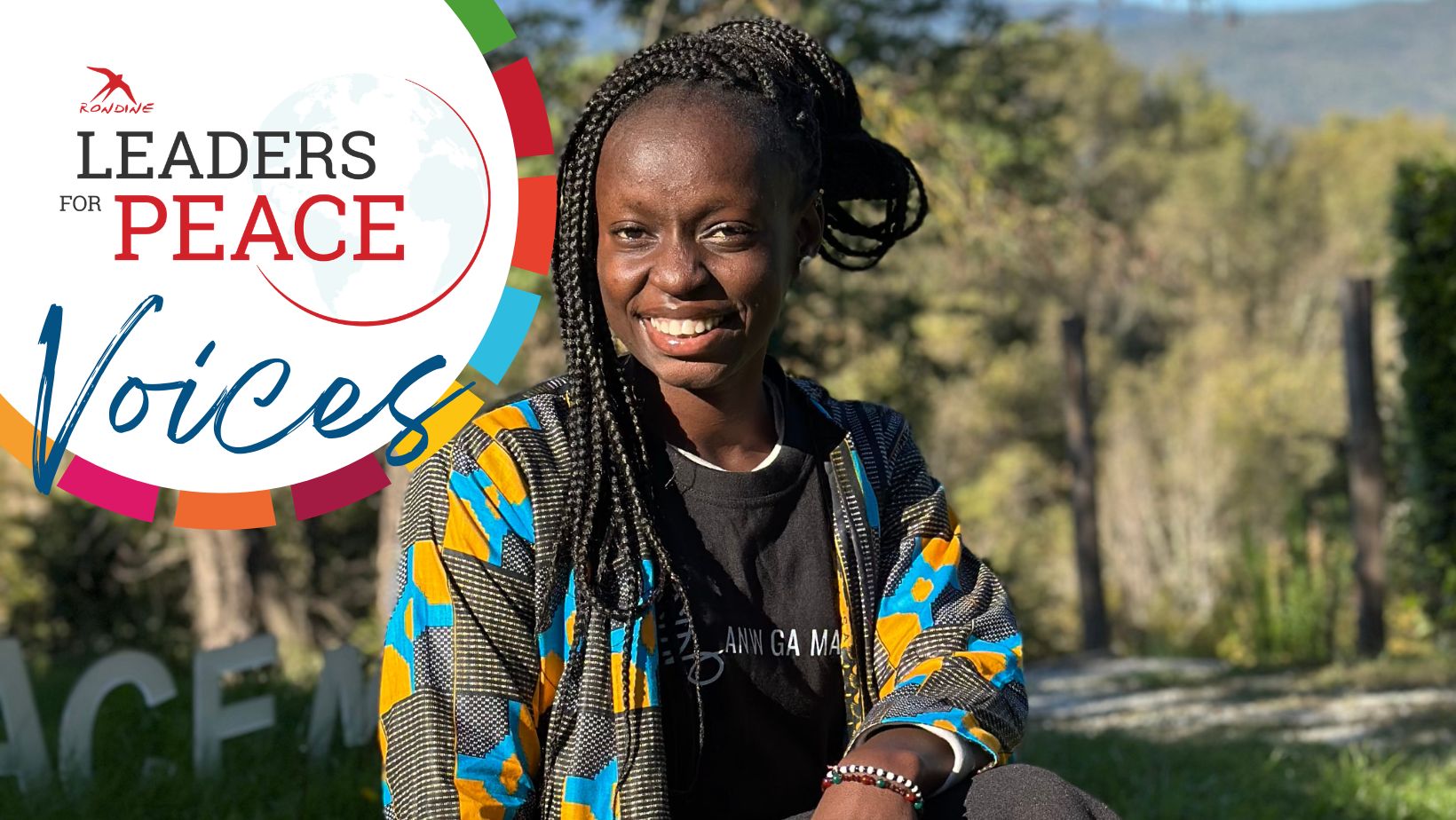
Bernadette, 25
I am a Malian journalist and communicator, and I have always been drawn to stories and storytelling. I hold a degree in Journalism and Communication and am currently enrolled in a Master’s programme in Corporate Communication, moving between media, associations and events. A poet at heart and a lover of challenges, I see Rondine as a mirror through which I get to know myself better. Today, I am developing a social impact project that explores youth responsibility and strengthens social cohesion.